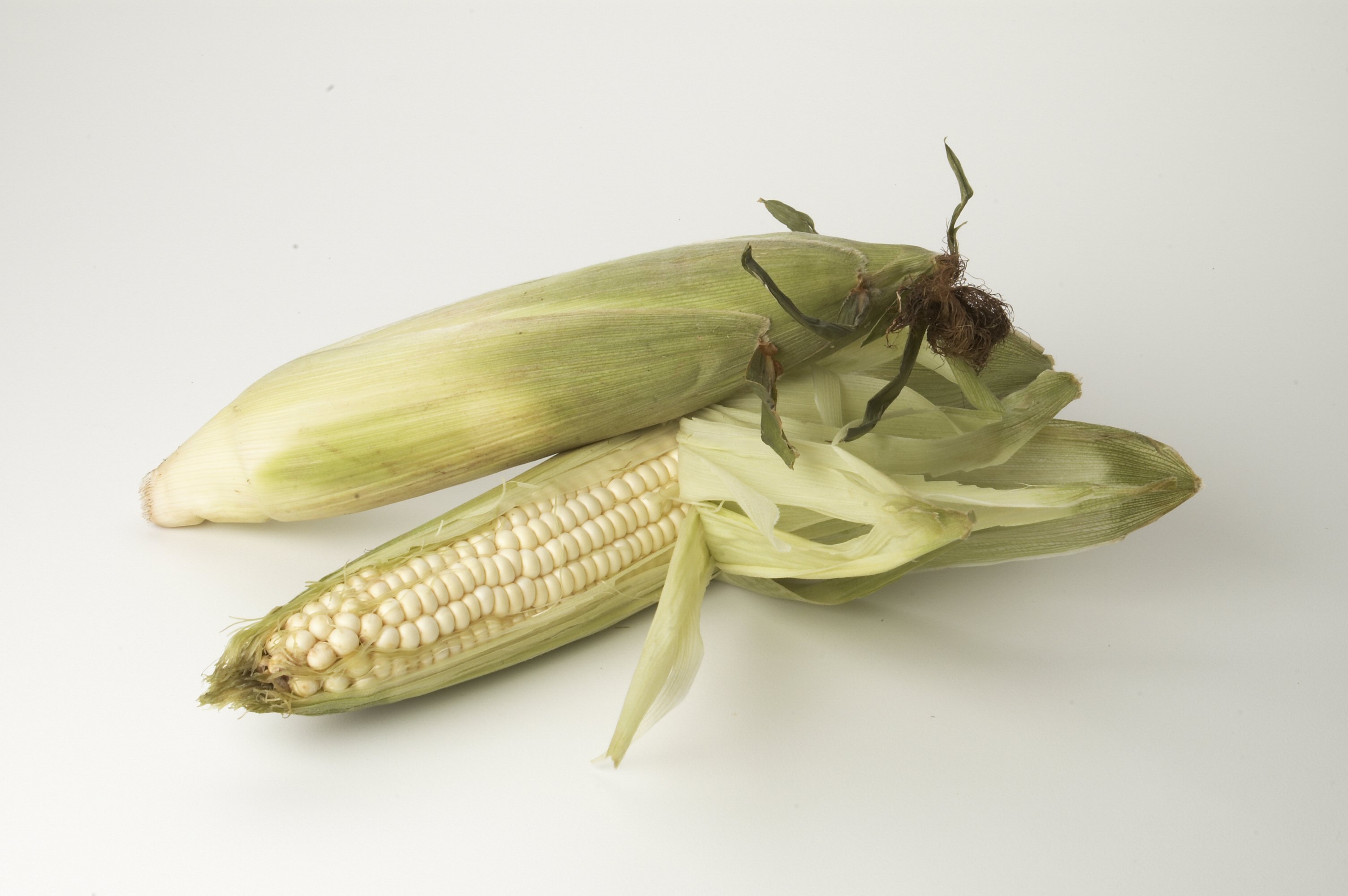
White Corn
Product Description:
Usage:
Boiled, microwaved or roasted.
Selection:
Good quality corn has full, evenly formed and filled ears with straight rows of kernels. The husks will be fresh-looking and bright green, and the silk ends free of decay or worm damage. Be sure the coloring of the kernels is bright and shiny. Pull back the husk and poke one of the kernels at the tip of the silk end with a finger-nail. If juice squirts out and is only slightly cloudy, it’s fresh. If the juice is thick or non-existent, the corn is old.
Avoid: Avoid corn that has shriveled, burned looking husks or has dark-colored slime in the tassel. Large kernels, those with dark yellow and dents and wrinkled kernels with no juice in them are all indications of old corn. Also avoid underdeveloped kernels lacking good color (except in the white variety) and short or crooked ears that are not filled almost to the tip with kernels.
Seasonal Information:
- Florida corn is available from October through June, peaking in April and June.
- California corn is available from May through October, peaking in June and July.
- Washington corn is available from July through October, peaking in August.
White Corn Nutritional Information
Serving Size: 154g
Amount Per Serving
Calories 132 Calories from Fat 15
% Daily Value*
Total Fat 2g
3%
Saturated Fat Fat 0g1%
Cholesterol 0mg
0%
Sodium 23mg
1%
Total Carbohydrate 29g
10%
Dietary Fiber 4g
17%
Sugars 5g
Protein 5g
Vitamin A 0%
Vitamin C 17%
Calcium 0%
Iron 4%
*Percent Daily Values are based on a 2,000 calorie diet. Your daily values may be higher or lower depending on your calorie needs.
Source: PMA’s Labeling Facts
White Corn is low in Saturated Fat, and very low in Cholesterol and Sodium. It is also a good source of Dietary Fiber, Vitamin C, Thiamin, Folate, Magnesium and Phosphorus.
Corn Tips & Trivia
* Maize is the proper word for corn, taken from the Indians of the New World who introduced it to European explorers and settlers. The word corn goes back to Biblical days, and means any particle of grain or any small pellet of anything. In some lands, corn meant wheat; in others it meant barley or oats. Only Americans adopted the word to describe maize. * In many American dialects, the word for corn meant, “that which gives us life.” Indeed, corn was the dietary staple of Indians. Aztec and Mayan civilizations were built on a corn economy, as corn provided food, currency, fuel, fodder for animals, silk for smoking, sugar and even fermented beverages.Product Packaging:
40 ct case
Product content provided by Produce Oasis